DeRomification

Martin van Creveld’s dictum—“diversity plus proximity equals war”—finds one of its purest historical expressions in the fate of Rome. The Roman Empire’s strength was not born of diversity, but of unity: a civic order rooted in an ethnically Roman core that radiated outward. Romanitas was more than law or language—it was the distilled self-conception of a people who had conquered the world and imposed upon it their sense of order. That civic identity, while in theory open to outsiders, always rested upon an ethnically Roman foundation.
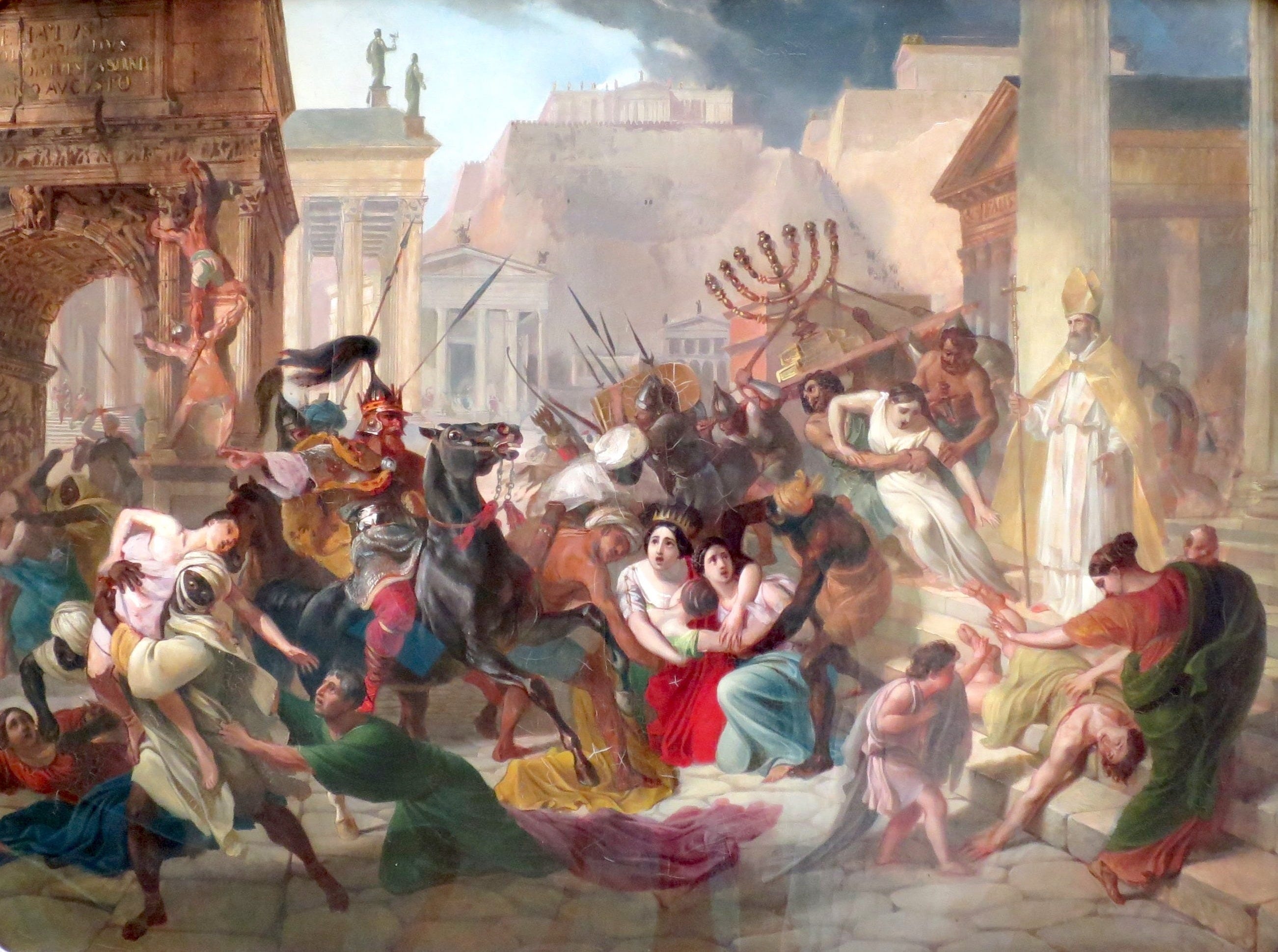
Genseric sacking Rome (1835), Karl Briullov
Over time, that foundation was diluted and then denationalized. As conquest slowed and demography shifted, Rome began importing men, culture, and authority from the provinces and frontiers. The army that had once been Roman became increasingly filled with Germans, Syrians, Illyrians, and Thracians—men who served Rome, but were not of it. The same process unfolded in the halls of power: emperors and generals, though Roman in title, were often foreigners by blood and temperament. What had once been a unified civic and ethnic organism turned into an administrative abstraction held together by pay and force.
In this new, “diverse” empire, proximity bred friction. Different peoples, bound together under the same imperial structure, sought to live by their own inherited ways—religiously, linguistically, and morally. The civic unity that had once overridden tribal difference dissolved, leaving only fragmented loyalties and local interests. When the crises of the fourth and fifth centuries struck, the Western Empire had no true Romans left to defend it—only subjects and mercenaries. The collapse was not simply military; it was civilizational. Rome had forgotten that its universal order had always rested upon a national soul.